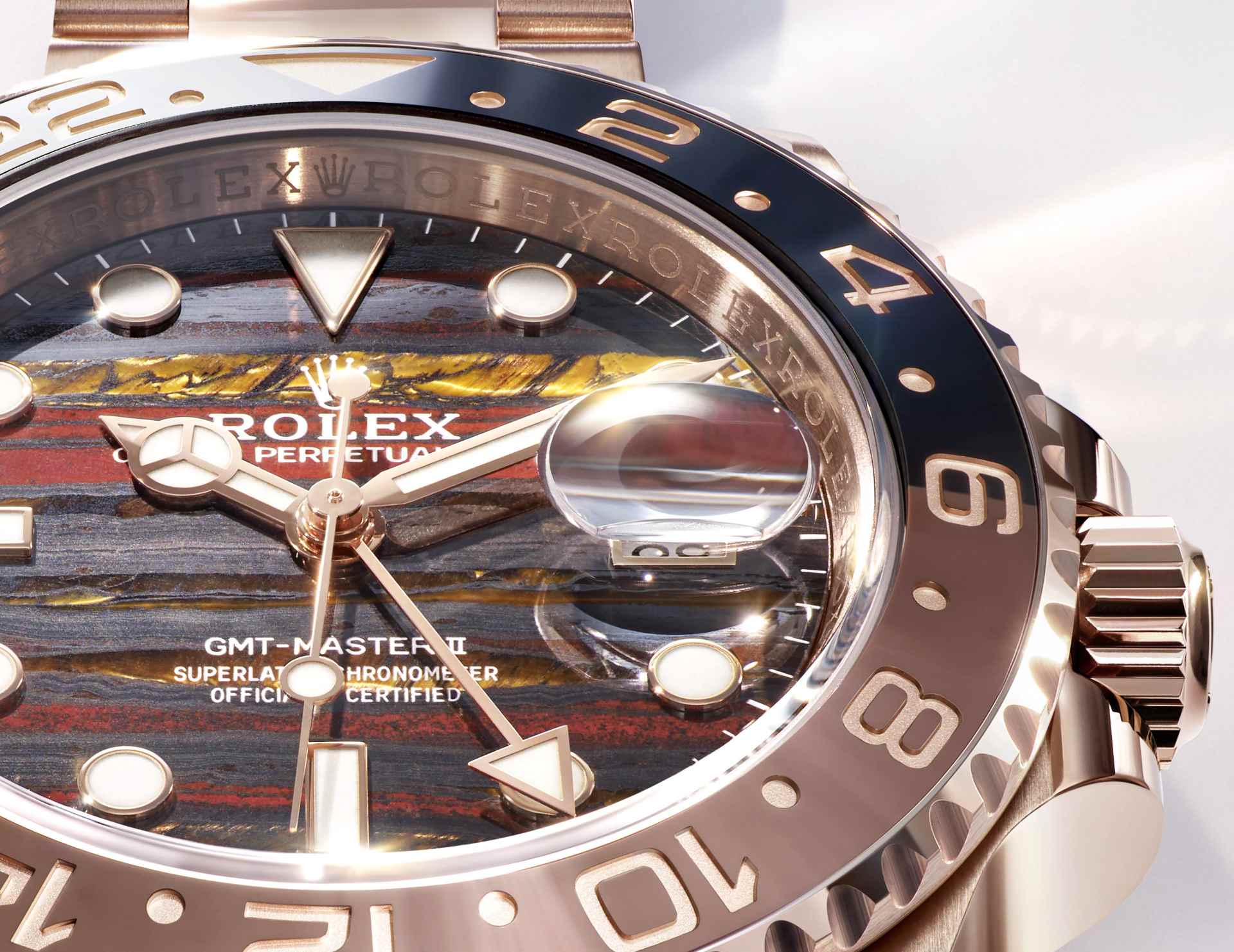
The Chêne-Bourg site, in the vicinity of Geneva, brings together all the activities linked to the development and production of the dial as well as those related to gemmology and gem-setting. This site is also where Cerachrom bezels and Cerachrom bezel inserts in high-tech ceramic are produced.
The manufacture of a Rolex dial requires a total of some 60 operations involving both the dial itself – made of brass or 18 ct gold – and the appliques, all in 18 ct yellow, white or pink gold. Some colouring operations using PVD (Physical Vapour Deposition) or lacquering are conducted in a clean room, a strictly controlled, dust-free environment. Some dials are decorated with mother-of-pearl, meteorite or semi-precious stones rigorously selected by Rolex according to quality standards that are unmatched on the market.
Rolex also has large resources in the field of electroplating, a specific colouring technology that also protects the dial.
The final steps in the production of the dial involve the transfer of inscriptions and motifs by pad-printing, the fitting of the appliques and the application of the Chromalight display, exclusive to Rolex. All of these operations are performed manually and give the dial its definitive identity.
Gem-setting
Diamonds, rubies, sapphires and emeralds: Rolex uses only the noblest of stones on its watches. Rigorously checked by the in-house gemmology department, which possesses sophisticated equipment and expertise usually found only in independent gemmology laboratories, each of these stones meets Rolex’s very stringent quality requirements.
Aside from the intrinsic quality of the stones, a number of criteria contribute to the reputation of Rolex’s gem-setting: the impeccable mounting of the gems, their alignment, orientation and position, and the finishing of the beads.
Ceramic workshop
Rolex has acquired specific equipment to produce its monobloc Cerachrom bezels and monobloc Cerachrom bezel inserts made of extremely hard and virtually scratchproof ceramic. The moulded graduations and numerals are coated with a thin layer of gold or platinum via PVD. Physical vapour deposition involves covering the material with a molecular film of an infinitesimal thickness. The process requires the use of a vacuum chamber where the pressure is equivalent to that found in space, 150 kilometres (95 miles) above the Earth’s surface.
In 2013, Rolex introduced two-colour, single piece Cerachrom bezel inserts in blue and black ceramic on the GMT-Master II model – a world first. These bezel inserts are manufactured through an impregnation process developed by Rolex and patented. They are now available in various colours, notably red and blue – a technological feat that required many years of research and development.