

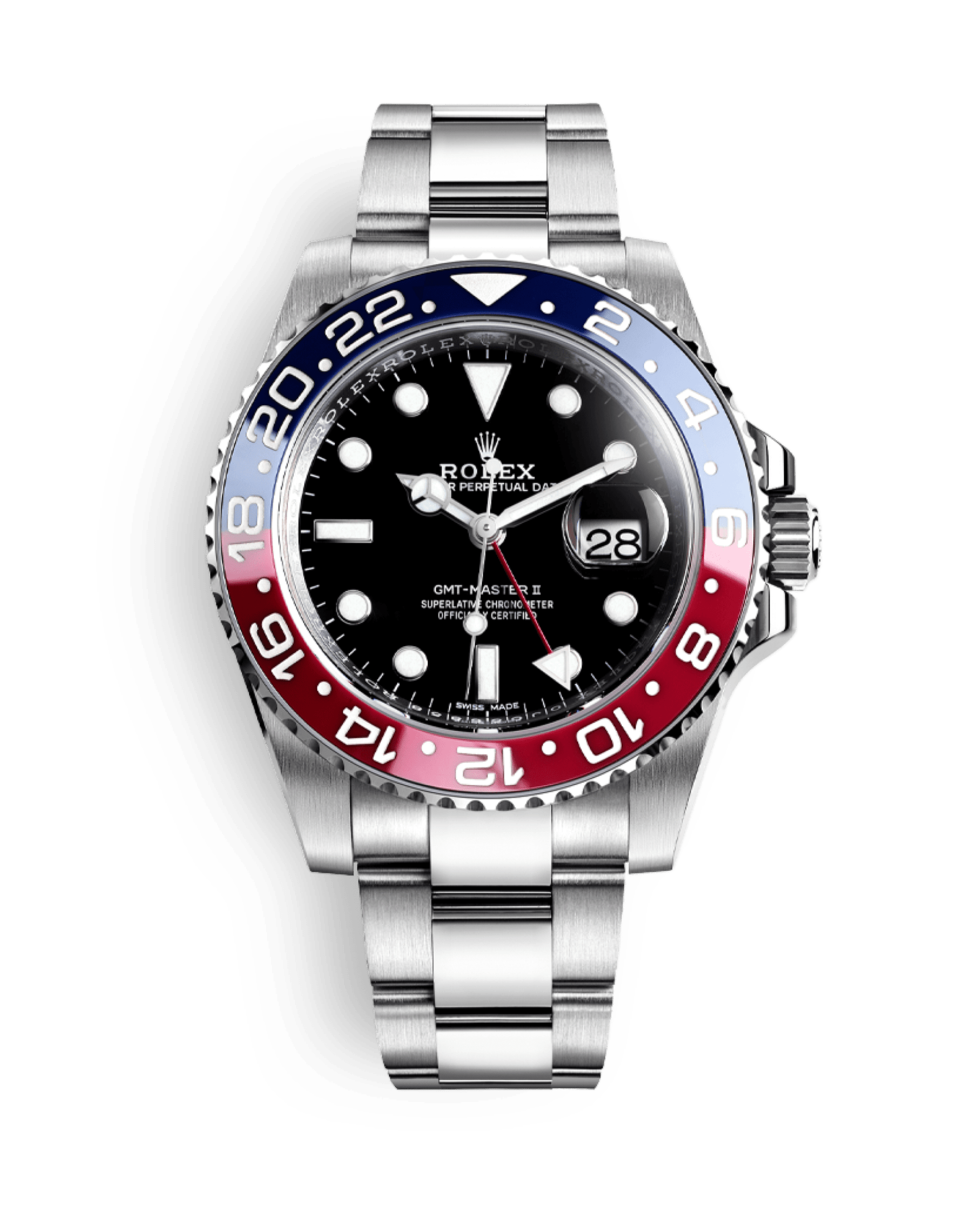

GMT-MASTER II
Time zone to time zoneDesigned for professionals criss-crossing the globe, the GMT‑Master became the watch of choice for travellers. Over the years, aviators, explorers, athletes and artists have all contributed to its legend. Today, its successor, the Oyster Perpetual GMT‑Master II, continues to embody this cosmopolitan spirit.



A new age of travel
The world was undergoing rapid change. Trade, travel and communication were on the rise across the globe. Distances seemed to be shortening and time seemed to be speeding up. With advances in aviation, the aeroplane had become an essential mode of transportation. The advent of long-haul flights now meant that it was possible to cross oceans and continents without stopovers. Keeping track of multiple time zones became a real challenge.
1950s

Launch of the
GMT-Master
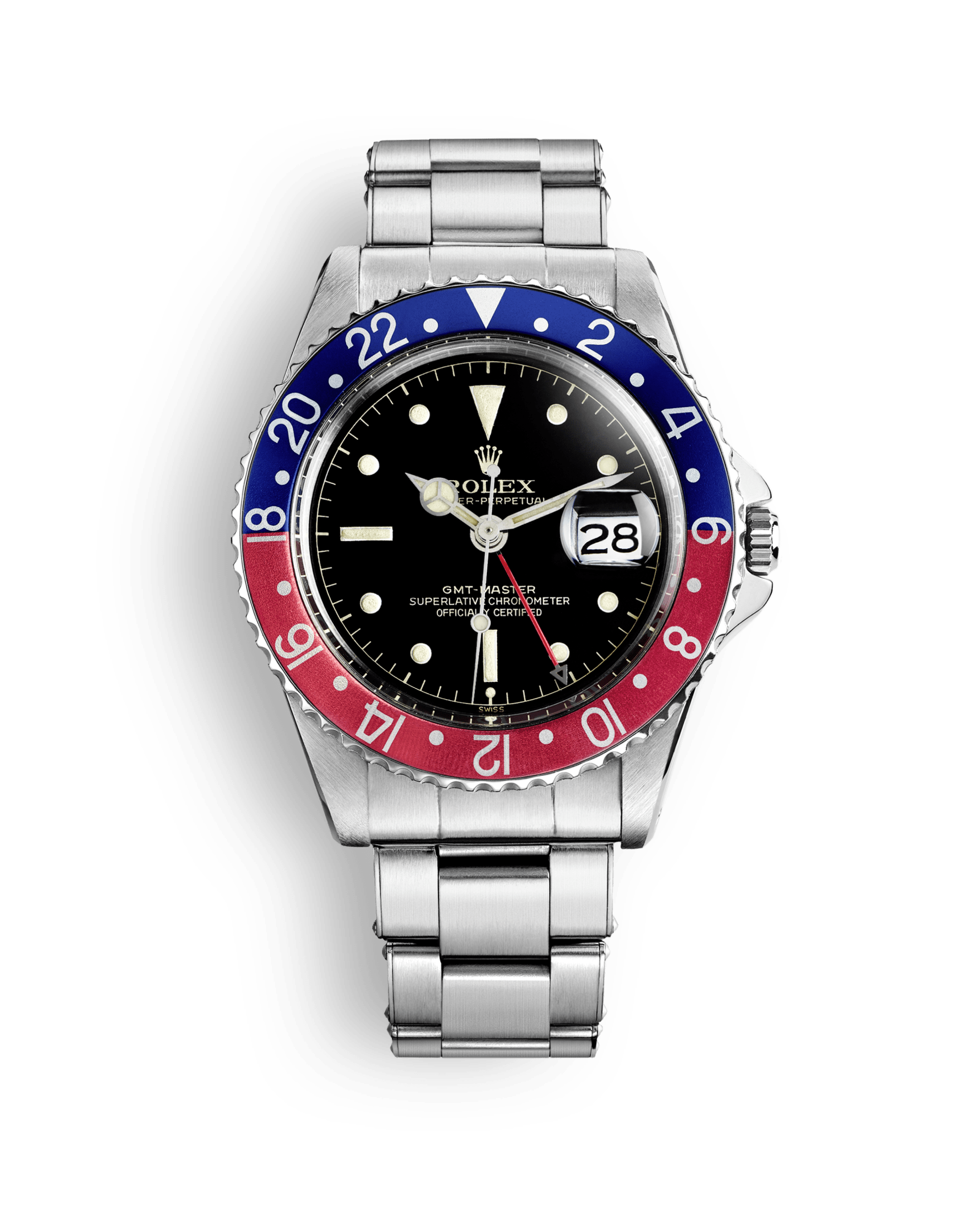
With its GMT function displaying two time zones, the GMT‑Master met the needs of professionals criss-crossing the globe. The letters GMT stand for ‘Greenwich Mean Time’, which was the international standard time until 1972, an essential reference point for all travellers.
1955

Pan Am’s watch
Rolex entered into a partnership with Pan American World Airways, otherwise known as Pan Am. The GMT‑Master thus became the official watch of the leading and largest American intercontinental airline at the time. Pan Am pilots were equipped with GMT‑Master models and featured in Rolex adverts, helping to establish this watch as an icon of the world of aviation.

New York – Moscow flight
The first non-stop flight by Pan Am between New York and Moscow carried journalists to the USSR to report on US Vice President Richard Nixon’s visit to the Soviet Union. At the controls of the Boeing 707 on this pioneering intercontinental journey was Captain C. N. Warren, who relied on his GMT‑Master as a navigation aid. He stated that “the flight itself was navigated by Rolex”.
1959

Alone around the world
Sheila Scott became the first British woman pilot to complete a solo flight around the world. On 18 May 1966, she was wearing a GMT‑Master when she took off from Heathrow Airport near London, England, at the controls of her single-engine Piper Comanche aircraft. She returned to her starting point on 20 June after making 31 stopovers and covering nearly 50,000 km (31,000 miles), logging a total of 189 flight hours over 34 days.
1966

An unsurpassed record
From 1959 to 1968, NASA and the US Air Force developed the X-15 programme. This hypersonic aircraft project was designed to test pilots’ ability to withstand the effects of extreme speeds and suborbital flight. Among its pilots, William J. Knight made history. On 3 October 1967, flying over California’s Mojave Desert with a GMT‑Master on his wrist, he reached a speed of 7,274 km/h (4,520 mph, or Mach 6.7), setting a record that remains unsurpassed to this day.
1967

Heading for the horizon
After seven months at sea and with a victory virtually guaranteed in the Sunday Times Golden Globe Race – the first solo, non-stop circumnavigation of the globe – Bernard Moitessier withdrew from the race and continued sailing. He declared: “I’m heading for the Pacific Islands, because I’m happy at sea.” Moitessier dropped anchor in Tahiti on 21 June 1969, having sailed more than 37,000 nautical miles with only a sextant and his GMT‑Master to guide him.
1969

The heart of the space conquest
On 11 April 1970, the Apollo 13 mission left Earth on what was to be the third American attempt at a moon landing. Among the personal items carried by command module pilot Jack Swigert was a watch he particularly valued: his GMT‑Master, which remained on his wrist throughout the mission like a good luck charm. Following a malfunction, the spacecraft returned to Earth earlier than planned. At the controls, Jack Swigert had to correct his course several times. On 17 April, the capsule splashed down in the Pacific Ocean between New Zealand and Fiji, its crew safe and sound.
1970

An icon of the silver screen
One of the most famous GMT‑Master watches is undoubtedly the one worn by Marlon Brando in Apocalypse Now, in which he played Colonel Walter E. Kurtz, a dissident US Army officer during the Vietnam War. Deeply attached to his watch, Brando chose to remove its iconic red and blue bezel himself – after it was considered too recognizable by the production team – rather than part with the watch. By engraving his name on the back of the case, Brando made it all the more unique.
1979

GMT‑Master II
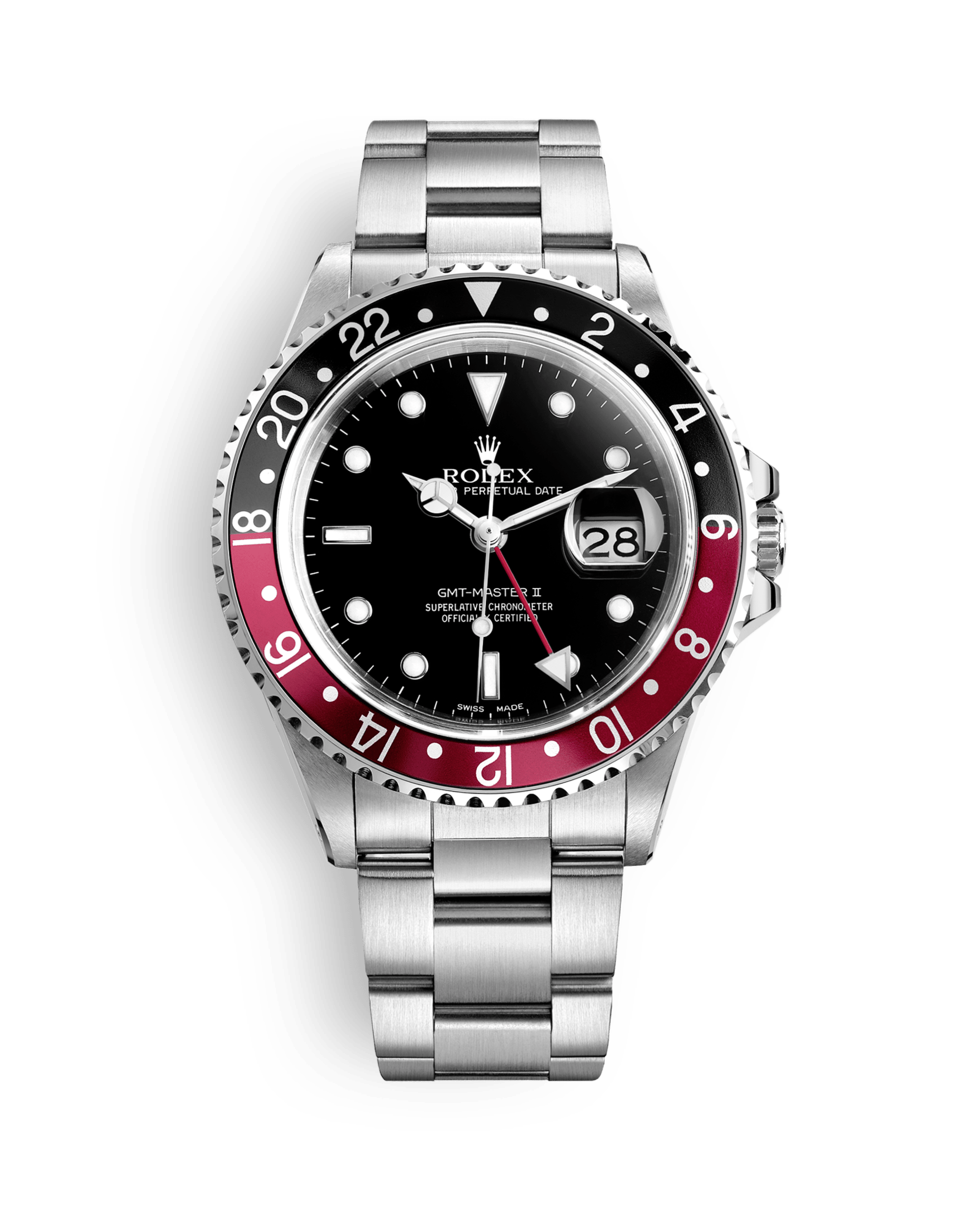
Rolex further refined the GMT‑Master, making it more comfortable and intuitive to use. In 1982, the brand introduced a new movement allowing the hour hand to be adjusted independently of the minute hand and the 24-hour hand. This major improvement was accompanied by a name change: the GMT‑Master fitted with this optimized movement was now known as the GMT‑Master II.
1982

The advent of ceramic
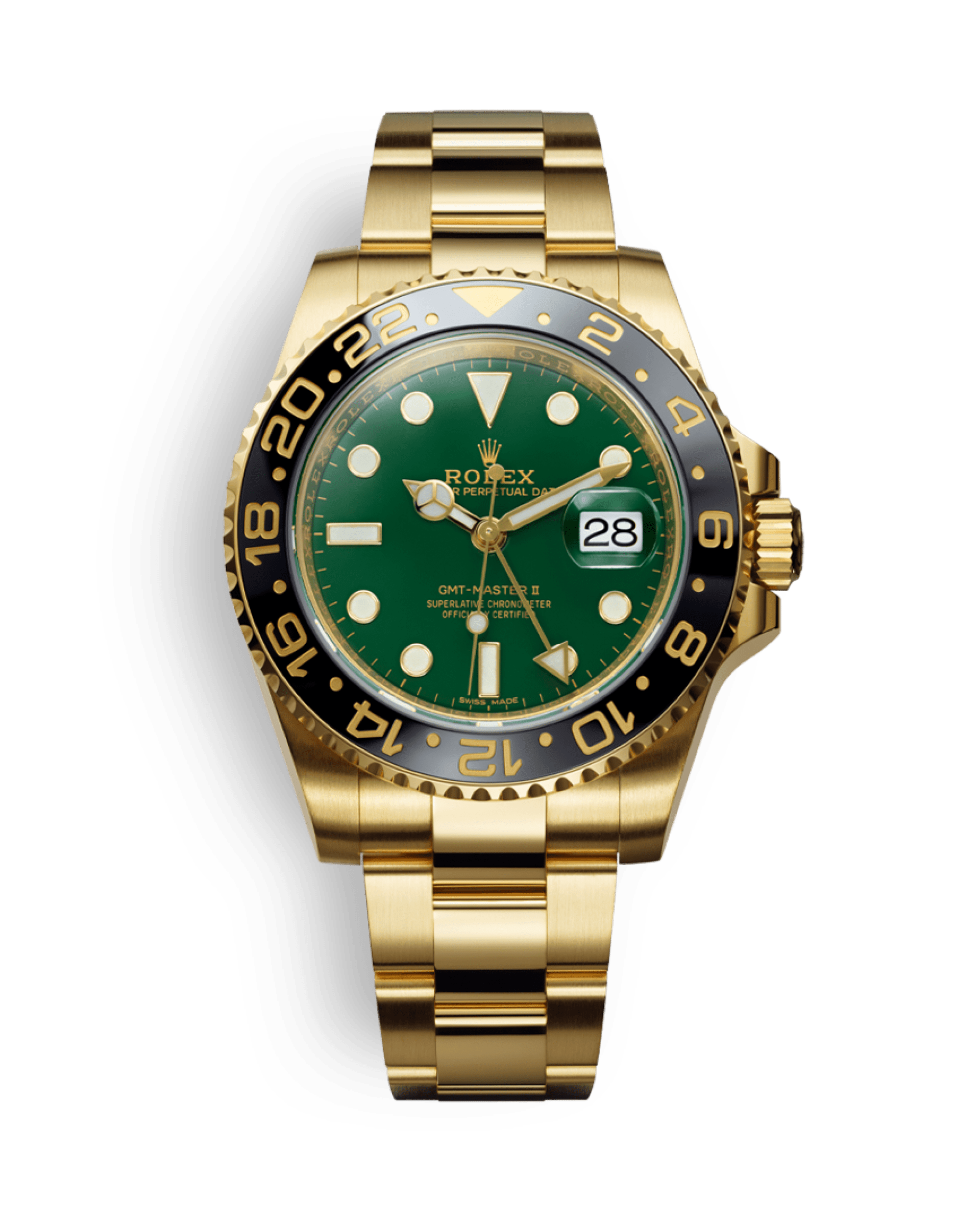
In 2005, the GMT‑Master II became the first Rolex watch to feature a Cerachrom bezel insert crafted from high-technology ceramic. Initially introduced in black and later in two-colour versions from 2013 onwards, it is robust, virtually scratchproof, resistant to both corrosion and ultraviolet rays, and its colour is unalterable.

2005
Rider at the top
Scott Brash achieved a historic milestone by winning, consecutively, the Grand Prix events of Geneva, Aachen and Spruce Meadows. In doing so, he became the first – and so far only – rider to win the Rolex Grand Slam of Show Jumping. Following his extraordinary achievement, the Scottish rider received a GMT‑Master II with a red and blue Cerachrom bezel insert. “Every time I look at it, it brings back memories of that day in Calgary.”

2015

Winding crown on the left
An unprecedented reinterpretation of the GMT‑Master II was unveiled. Equipped with a green and black Cerachrom bezel insert, it is distinguished by a winding crown positioned on the left side of the case. Another distinctive feature is its date display, which appears at 9 o’clock on the dial. At the time of its launch, this version of the GMT‑Master II was the only Rolex watch to present such a configuration. Through this unique design, Rolex reaffirmed its commitment to meeting the needs and preferences of every wearer.
2022

First Cerachrom dial
Rolex introduced its first dial made from high-technology ceramic. In green, this new Cerachrom component debuted on an 18 kt white gold Oyster Perpetual GMT‑Master II featuring a left-side winding crown and a date display at 9 o’clock.